

Global Small Satellite Market to Hit USD 22.0 Billion by 2036, Asia Pacific Leads Growth with Airbus, Boeing & Lockheed.
Small Satellite Market
Small Satellite Market to reach USD 22.0B by 2036 at 12.7% CAGR, driven by LEO constellations, defense demand, and 5G-enabled IoT connectivity growth.
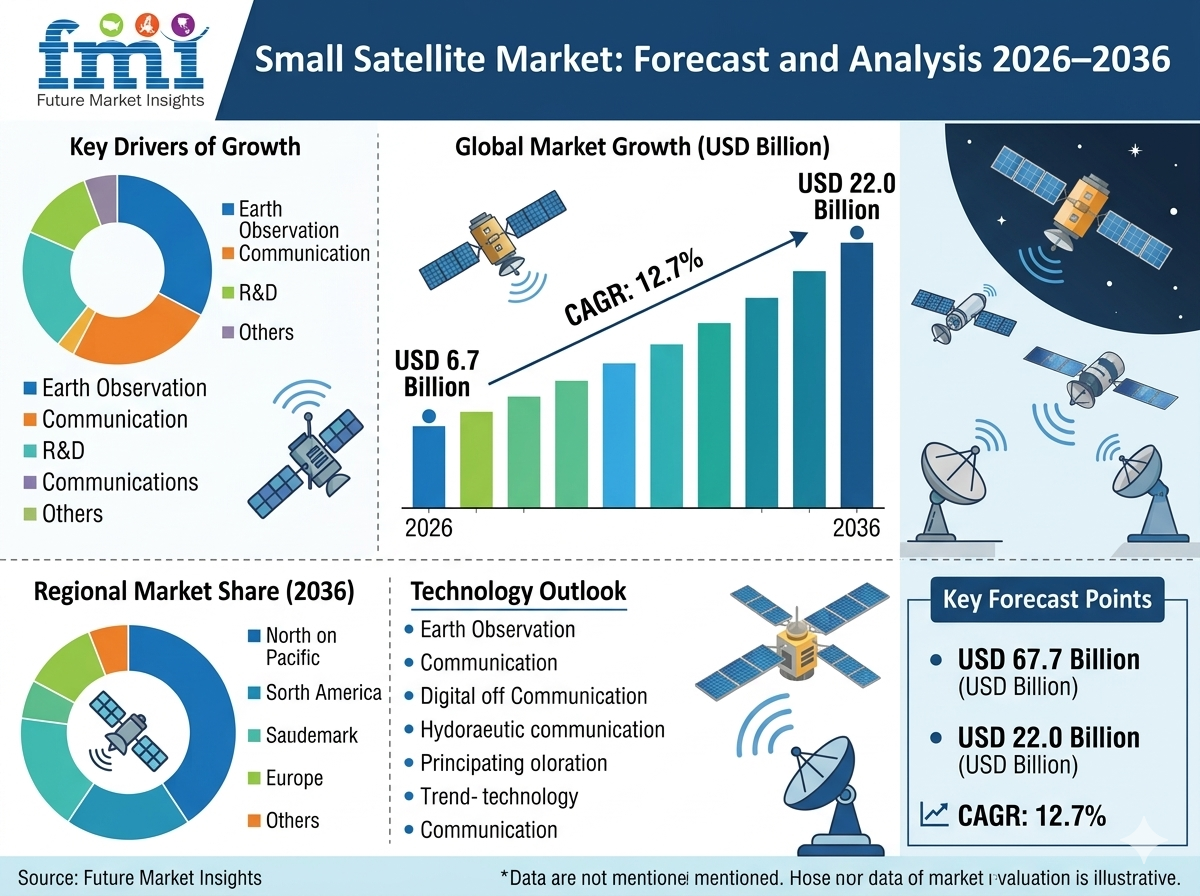
NEWARK, DE, UNITED STATES, April 1, 2026 /EINPresswire.com/ -- The global Small Satellite Market is valued at USD 6.7 billion in 2026 and is projected to reach USD 22.0 billion by 2036, expanding at a CAGR of 12.7% during the forecast period. Growth is fueled by the rapid deployment of low Earth orbit (LEO) mega-constellations, increasing defense investments, and the rising adoption of satellite-enabled IoT and 5G connectivity solutions.
As global connectivity shifts toward decentralized and high-speed infrastructure, small satellites are emerging as a transformative force in modern telecommunications, defense intelligence, and earth observation. Their ability to deliver real-time data with reduced latency and cost efficiency positions them at the core of next-generation space ecosystems.
Request Sample Report | Customize Report | Purchase Full Report
https://www.futuremarketinsights.com/reports/sample/rep-gb-3298
Small Satellite Market Snapshot (2026–2036)
• Market size in 2026: USD 6.7 billion
• Market size in 2036: USD 22.0 billion
• CAGR (2026–2036): ~12.7%
• Leading type: Minisatellite (28.0%)
• Dominant orbit: Low Earth Orbit (LEO) (79.6%)
• Top application: Military Intelligence (38.2%)
• High-growth regions: China, India, Germany
• Key companies: Global aerospace leaders and emerging space innovators
Market Momentum
The small satellite market begins at USD 6.7 billion in 2026, driven by accelerating demand for global connectivity and real-time earth observation. Between 2027 and 2030, the expansion of mega-constellations for satellite internet and communication services significantly boosts deployment frequency, improving coverage and reducing latency.
Entering 2032 and beyond, advancements in onboard processing, AI-enabled payloads, and edge computing capabilities transform satellite operations, enabling real-time analytics directly in orbit. Increased collaboration between private companies and government agencies further strengthens the ecosystem.
By 2036, the market reaches USD 22.0 billion, supported by widespread adoption across telecommunications, defense, agriculture, logistics, and smart city applications.
Why the Market is Growing
The Small Satellite Market is expanding as industries increasingly demand scalable, low-cost, and high-performance space-based solutions. Unlike traditional satellites, small satellites offer faster deployment cycles, lower manufacturing costs, and greater flexibility, making them ideal for dynamic applications.
The proliferation of LEO constellations is a primary growth driver, enabling low-latency communication essential for 5G networks, IoT ecosystems, and real-time data transmission. These constellations allow continuous global coverage, revolutionizing internet accessibility in remote and underserved regions.
Additionally, defense agencies worldwide are increasing investments in distributed satellite architectures to enhance surveillance capabilities and resilience against anti-satellite threats. The shift toward commercial-off-the-shelf (COTS) components is further lowering entry barriers, allowing startups and academic institutions to participate in space missions.
Standardized satellite platforms and modular designs are also improving manufacturing efficiency, reducing production timelines from years to months, and accelerating time-to-market.
Segment Spotlight
1. Type: Minisatellites Lead Market Share
Minisatellites account for approximately 28.0% of the market, driven by their optimal balance between payload capacity, durability, and mission reliability. Their ability to support advanced imaging and radar systems makes them ideal for government and scientific applications.
2. Orbit Type: LEO Dominates
Low Earth Orbit (LEO) holds around 79.6% share, fueled by the rapid deployment of mega-constellations for communication and earth observation. Its proximity to Earth enables faster data transmission and reduced latency.
3. Application: Military Intelligence Leads
Military intelligence dominates with a 38.2% share, supported by increasing geopolitical tensions and the need for continuous surveillance and secure communication systems.
Drivers, Opportunities, Trends, Challenges
• Drivers: Rising demand for real-time connectivity, defense modernization, and satellite-based IoT
• Opportunities: Space-as-a-Service models, AI-powered satellite analytics, and edge computing in orbit
• Trends: Mega-constellations, reusable launch systems, onboard data processing, and standardized satellite buses
• Challenges: Space debris risks, regulatory compliance, and launch scheduling constraints
Country Growth Outlook (2026–2036)
China leads the market with a CAGR of 17.1%, driven by large-scale government-backed satellite programs and 5G integration initiatives. India follows at 15.9%, supported by rapid digital transformation and expanding private sector participation in space technology.
Germany records a CAGR of 14.6%, leveraging its strong engineering base and innovation in satellite components. The United States (12.1%) maintains leadership in commercialization and venture-backed space initiatives, while the United Kingdom (10.8%) focuses on strengthening sovereign satellite capabilities and connectivity infrastructure.
Competitive Landscape
The small satellite market features intense competition among global aerospace giants and emerging space startups. Leading companies are focusing on vertical integration, combining satellite manufacturing, launch services, and data analytics to deliver end-to-end solutions.
Strategic partnerships with launch providers and cloud computing platforms are enabling seamless deployment and data processing capabilities. Companies are also investing in advanced manufacturing technologies, AI-driven payloads, and modular satellite architectures to enhance performance and reduce costs.
Competition is increasingly centered on launch efficiency, service reliability, and the ability to deliver actionable insights through satellite-generated data. Agile startups leveraging cost-effective components are disrupting traditional players, pushing the industry toward faster innovation cycles.
Frequently Asked Questions (FAQ)
What is the global Small Satellite Market size?
The market is valued at approximately USD 6.7 billion in 2026 and is projected to reach USD 22.0 billion by 2036.
At what rate is the market expected to grow?
The market is forecast to expand at a CAGR of about 12.7% from 2026 to 2036.
What are small satellites?
Small satellites are compact, cost-effective spacecraft designed for applications such as communication, earth observation, and scientific research.
Why are small satellites gaining popularity?
They offer faster deployment, lower costs, and scalability, making them ideal for modern connectivity and data-driven applications.
Explore More Related Studies Published by FMI Research:
Automated Guided Vehicles (AGV) Market - https://www.futuremarketinsights.com/reports/automated-guided-vehicles-market
AutomotiveAutomotive Wiring Harness Market - https://www.futuremarketinsights.com/reports/global-automotive-wiring-harness-market
AutomotiveTurboexpander Market - https://www.futuremarketinsights.com/reports/turboexpander-market
About Future Market Insights (FMI)
Future Market Insights, Inc. (FMI) is an ESOMAR-certified, ISO 9001:2015 market research and consulting organization, trusted by Fortune 500 companies and global enterprises. With a strong presence across the United States, United Kingdom, India, and the Middle East, FMI delivers actionable insights across 30+ industries and over 1,200 markets worldwide.
Why Choose FMI:
https://www.futuremarketinsights.com/why-fmi
Sudip Saha
Future Market Insights Inc.
+1 347-918-3531
rahul.singh@futuremarketinsights.com
Legal Disclaimer:
EIN Presswire provides this news content "as is" without warranty of any kind. We do not accept any responsibility or liability for the accuracy, content, images, videos, licenses, completeness, legality, or reliability of the information contained in this article. If you have any complaints or copyright issues related to this article, kindly contact the author above.
