

BigBlueBam Public Beta Brings AI-Native Architecture to Open-Source Project Management, CRM, and Knowledge Work
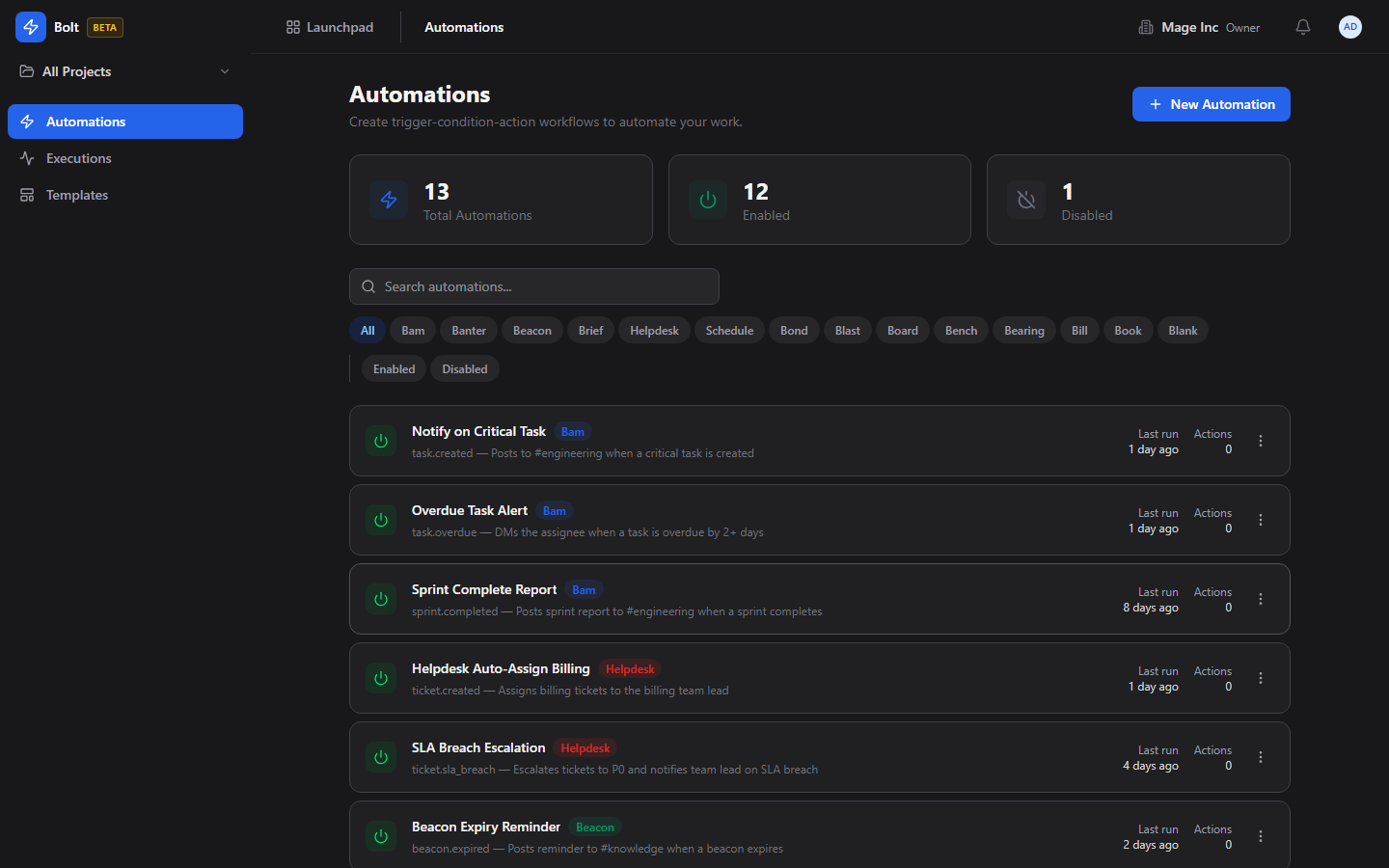
Bolt Automations expose the MCP to humans and AI alike
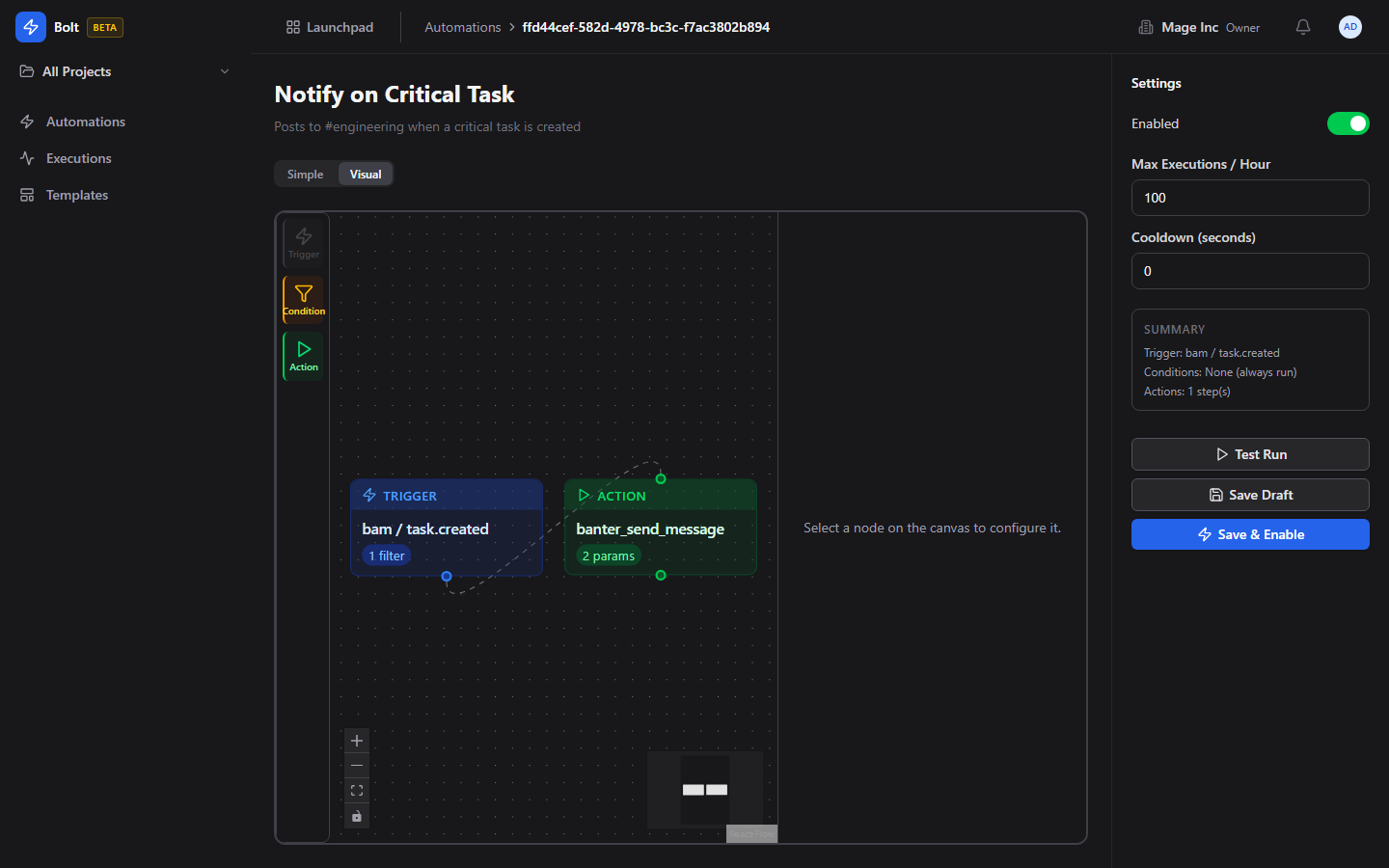
The node graph interface for Bolt
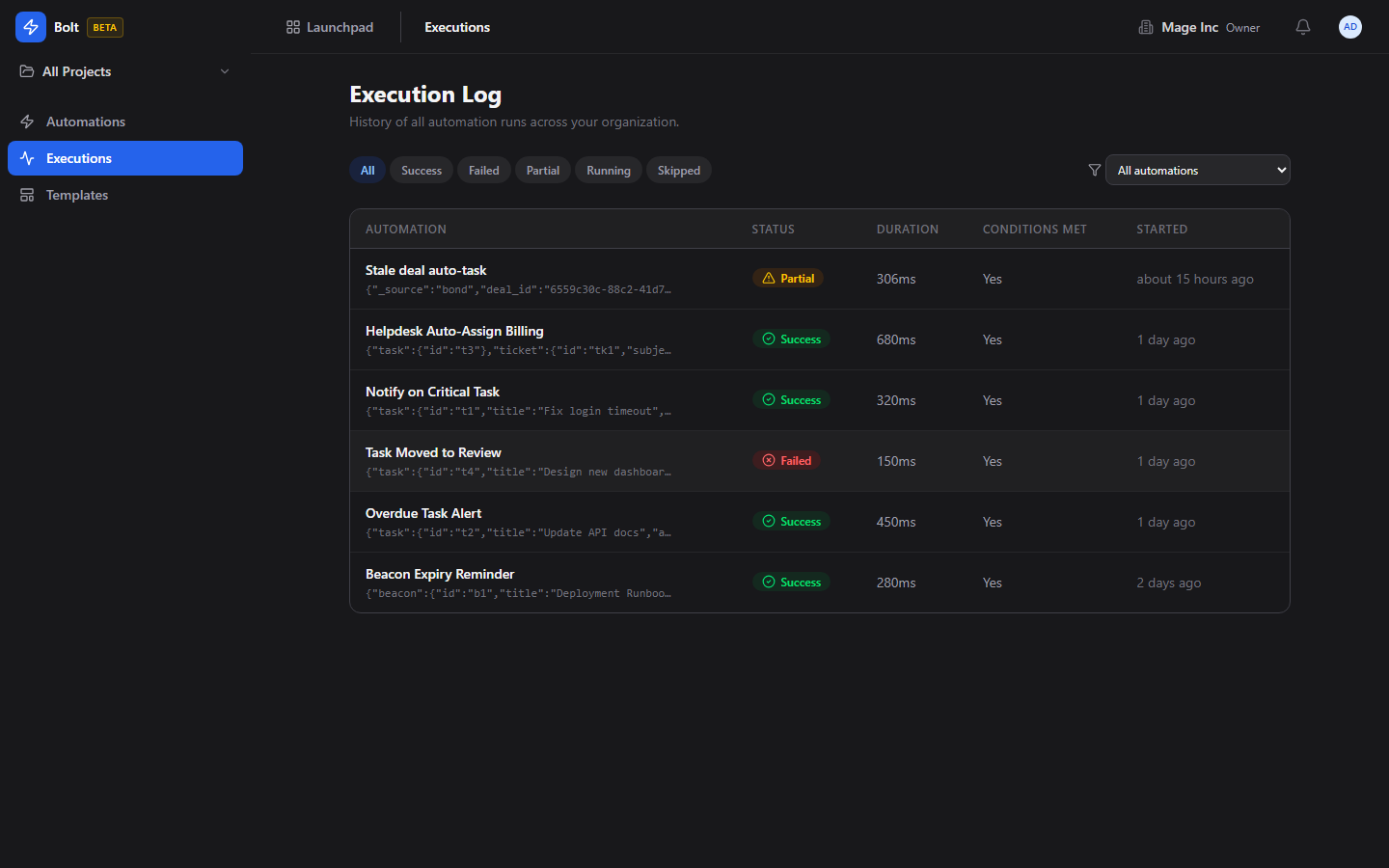
Bolt Executions show a history of Bolt Automations performed by both humans and AI agents
Exposes 340 MCP tools across 20 applications, a surface comparable to Azure MCP Server, aimed at the daily work of knowledge workers, released under MIT license
BigBlueBam, entering public beta this month, ships with an MCP server exposing 340 tools spanning all 20 applications in the suite. Every project-management action in Bam, every message operation in Banter, every knowledge-base query in Beacon, every invoice action in Bill, every CRM update in Bond, and every automation in Bolt is addressable through the MCP surface. It is the largest MCP-native work suite shipped to date, at Microsoft-comparable scale, built by a single developer rather than a corporate engineering org, and MIT-licensed rather than tied to a commercial cloud.
"MCP is the interesting standards story in AI infrastructure right now, and most vendors outside the cloud platforms are treating it as a novelty," Offermann said. "The thing that actually matters about MCP is not that it lets your chatbot call tools. It is that it provides a unified execution substrate for agents. If you take that seriously, it changes how you architect everything downstream."
A Different Category of Deployment
The large first-party MCP servers that exist today, including Azure MCP, AWS's MCP suite, Google Cloud's, and GitHub's, are management planes. They let developers and SREs provision resources, query metrics, run diagnostics, and deploy services. Their user is an operator managing infrastructure.
BigBlueBam's MCP server operates a layer above, on the applications knowledge workers use for their actual jobs. Creating a task in Bam is not managing a task service; it is the work. Writing in Beacon is not configuring a knowledge base; it is the knowledge. Sending a message in Banter is not operating a messaging service; it is the communication. The user is a human doing their daily job, and MCP is what lets an agent act alongside them inside the work, not through a dashboard behind it.
The Substrate Argument
BigBlueBam's MCP server is not a thin wrapper over the product's existing REST API. It is the product's primary agent surface. Permissions are enforced through the same role-based access-control system that governs human users. Every MCP tool call generates an audit log entry. Every tool result is scoped to the authenticated agent's visibility.
That design has a second, less obvious consequence: it unifies human-authored automation with agent action.
Bolt, BigBlueBam's workflow automation engine, compiles visual rules ("when a Bam ticket is assigned to priority-high, notify the #incidents channel in Banter and create a Beacon incident document") down to chained MCP calls. A human-authored automation and an AI agent's action therefore run through the same execution path, under the same permission system, producing the same audit trail.
"Once MCP is the execution layer, the distinction between 'the AI did it' and 'the automation did it' and 'a person clicked a button' collapses into a single record of what happened, who caused it, and whether they were authorized," Offermann said. "That is what compliance actually looks like when it has been designed in from the start."
Scale of the Deployment
BigBlueBam's 340-tool MCP registry breaks down approximately as follows (counts approximate, growing):
- Project and task management tools (Bam): ~45
- Team communication tools (Banter): ~35
- Knowledge base and document retrieval tools (Beacon, Brief): ~45
- Automation and workflow tools (Bolt): ~25
- CRM and contact management tools (Bond, Blast): ~35
- Billing, invoicing, and time tracking tools (Bill, Bank): ~25
- Scheduling, availability, and HR tools (Book, Balance, Belong): ~35
- Dashboard, reporting, and analytics tools (Bench, Bridge): ~20
- File, asset, and canvas tools (Bin, Board, Badge): ~25
- Forms, surveys, OKRs, and cross-cutting tools (Blank, Bearing): ~20
- Helpdesk and other suite tools: ~30
Every tool is documented with JSON Schema for both inputs and outputs. Every tool's permissions are declared in the same RBAC table that governs human role grants.
Why the Architecture Is Hard to Copy
The unified MCP surface is only possible because BigBlueBam is built on a single PostgreSQL schema shared across all 20 applications. Most enterprise SaaS vendors grew through acquisition and hold customer data in separate databases per product. Retrofitting an MCP-style unified tool surface across those databases would require either invasive schema migrations (breaking paying customers) or a translation layer that would defeat the atomic-transaction guarantees that make the architecture defensible.
"Incumbent vendors can ship an MCP demo," Offermann said. "What they cannot ship is an MCP substrate, because they don't have a unified data model underneath it. That is the competitive dynamic that matters for the next five years."
Availability
BigBlueBam is available in public beta starting now under the MIT license. Source code, deployment documentation, Docker Compose files, and migration tooling are available on GitHub.
Teams with the infrastructure and expertise to self-host are encouraged to do so; the project targets deployments from 2 to 100 people on a single commodity Docker host, with larger installations possible through self-hosted scaling on DigitalOcean, Railway, or on-premises infrastructure.
For teams who would rather not run their own stack, Big Blue Ceiling will roll out managed hosting later this year, along with an Agent Store that simplifies deployment of advanced AI agents into a BigBlueBam workspace. Additional commercial offerings are planned. The core suite will remain MIT-licensed and self-hostable in perpetuity.
About BigBlueBam
BigBlueBam is an open-source, AI-native work operating system comprising 20 interoperating applications covering project management, team communication, knowledge management, automation, CRM, HR, and more. The suite is MIT-licensed, self-hostable, and built on a unified PostgreSQL schema with AI agents treated as first-class users. BigBlueBam is a project of Big Blue Ceiling Prototyping & Fabrication, LLC.
Robert Offermann
Big Blue Ceiling
contact@bigblueceiling.com
Visit us on social media:
LinkedIn
Legal Disclaimer:
EIN Presswire provides this news content "as is" without warranty of any kind. We do not accept any responsibility or liability for the accuracy, content, images, videos, licenses, completeness, legality, or reliability of the information contained in this article. If you have any complaints or copyright issues related to this article, kindly contact the author above.
