

The AI Lab Invites NVIDIA, Meta, OpenAI, Google and Microsoft to use TIP, Permanent, Quantum-Safe Proof of Who Made What
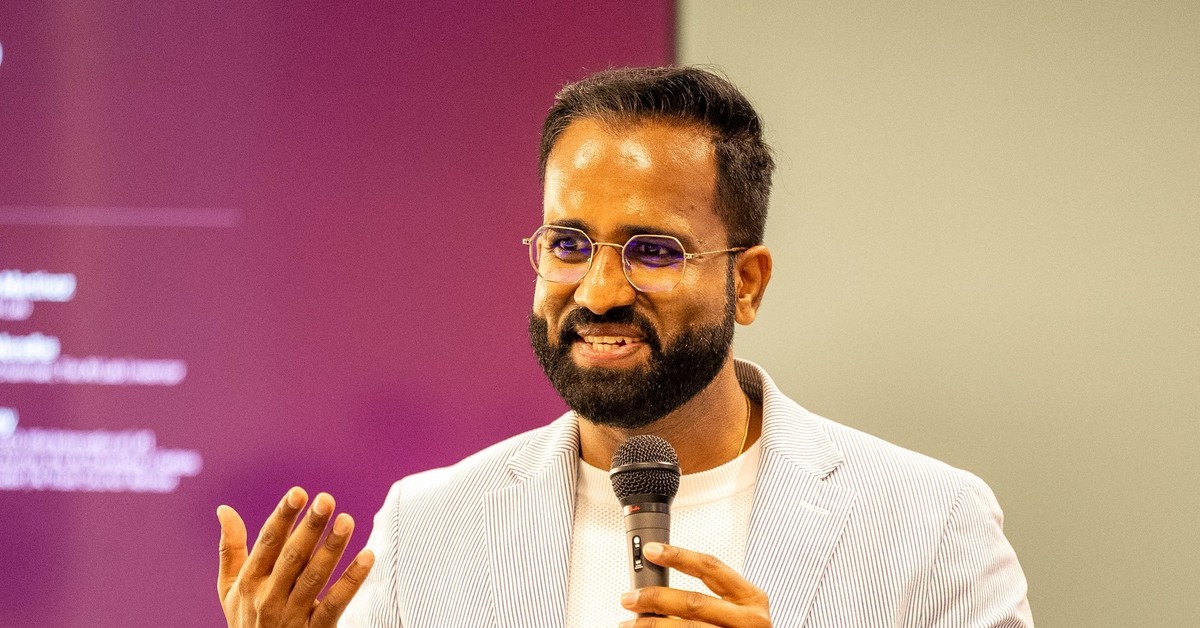
Dinesh Mendhe, Founder and Chairman of The AI Lab and inventor of the Trust Identity Protocol (TIP), speaks at the TIP pre-launch during OC Tech Week, EvoNexus Irvine, October 20, 2026. Photo by COLDEA Productions.
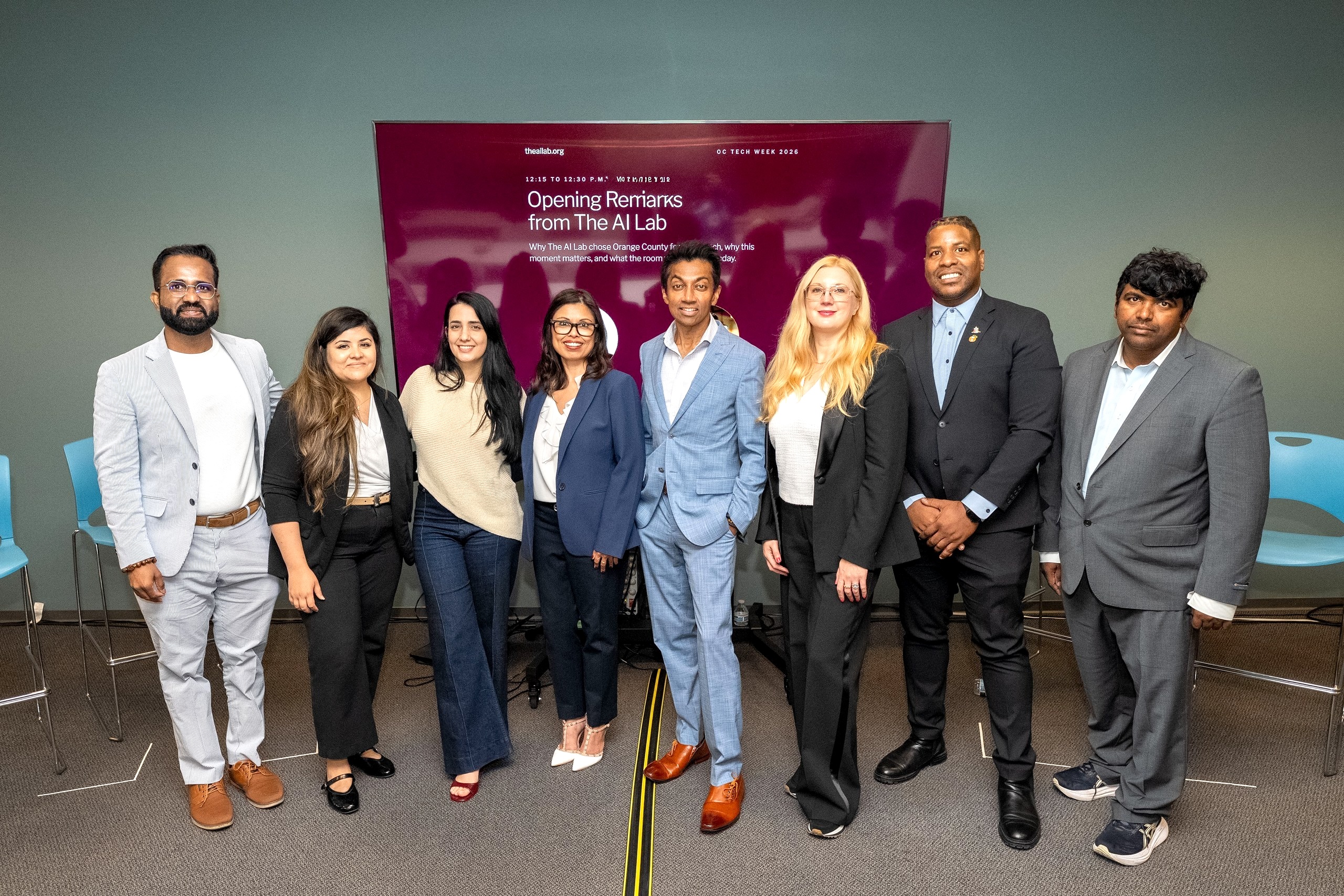
The AI Lab team and partners at the Trust Identity Protocol pre-launch, OC Tech Week, EvoNexus Irvine, October 20, 2026. Photo by COLDEA Productions.
With U.S. midterms days away and deepfakes on the rise, TIP pre-launched at OC Tech Week, backed by more than 15 node operators in eight countries
IRVINE, CA, UNITED STATES, October 23, 2026 /EINPresswire.com/ -- The AI Lab, the organization behind the Trust Identity Protocol (TIP®), is inviting NVIDIA, Meta, OpenAI, Google, and Microsoft to adopt its open, post-quantum standard for proving who made what. Dinesh Mendhe, Founder and Chairman of The AI Lab and the inventor of TIP, says the protocol, built over two and a half years, is ready to give frontier AI companies what watermarks have not: a record of who made a piece of content, and when, that a stripped copy cannot erase.The invitation follows a month of developments that have put the AI industry under pressure. Developers published tools that strip the invisible watermarks Anthropic added to text from its Claude models. Anthropic's own researchers warned that self-replicating AI agents may be months away. Researchers at OpenAI, Wiz, and Calif disclosed PHP2Shell, critical flaws in the PHP programming language, found with help from AI, that could affect about 70 percent of the internet. And California Attorney General Rob Bonta warned of a sharp rise in crypto scams aimed at Gen Z that use deepfakes and voice clones.
"We need to end this nightmare for people," said Mendhe. "It took my team and me two and a half years to get this right. The technology is ready, and I am ready to meet with NVIDIA, Meta, OpenAI, Google, and Microsoft to discuss solutions that protect humans across the entire world."
The AI Lab officially pre-launched TIP at OC Tech Week on October 20, 2026, at EvoNexus Irvine, to a focused group spanning Gen Alpha to Boomers. According to The AI Lab, more than 15 Founding Node Operators in eight countries, the United States, Canada, the United Kingdom, Spain, Cyprus, India, Australia, and New Zealand, have signed on to run the TIP Network, so that no single company or country controls the record. With U.S. midterm elections set for November 3, The AI Lab says voters, campaigns, and newsrooms all need a reliable way to check where content came from.
FOX 11 Los Angeles featured a segment from the event's debate, "The People vs. The AI Lab," which centered on one question: who is responsible when someone's identity is stolen between now and Q-Day, the point at which quantum computers are expected to break the encryption most of the internet relies on? Participants debated accountability, California SB 574, brand reputation, and the future of journalism.
"Everyone in that room wanted to know when Q-Day will come," said Dr. Sofia Martinez, Chief Executive Officer and President of The AI Lab. "The better question is what is already breaking. We are living through daily rehearsals, and AI is running them."
Watermarks can be removed, but TIP is permanent proof that stays on the record.
A watermark lives inside a file, and the person making a fake controls the file. TIP takes a different approach. It connects three layers into one record that anyone can check.
Verified identity. Each person or organization receives a TIP-ID after a one-time identity verification.
A content fingerprint. Each piece of content is fingerprinted with SHAKE-256, a hashing function from the NIST FIPS 202 standard. If a single word changes, the fingerprint no longer matches.
A post-quantum signature on a shared ledger. Each record is signed with ML-DSA-65, a signature algorithm in the NIST FIPS 204 post-quantum standard, and kept on the TIP Network, a ledger organized as a directed acyclic graph (DAG) and run on many independent nodes, with no single company or country in control.
A copy can be stripped of its label, but the signed record of the original cannot be quietly rewritten. The AI Lab says the tools people rely on today, such as watermarks and metadata, are not robust enough to be tamper-proof or immutable, and that TIP is built to give every person that assurance.
The AI Lab says TIP is designed to sit alongside the tools AI companies already use, including watermarking and C2PA Content Credentials, by adding the two things those tools leave out: a verified human or organization behind the content, and a signature built to outlast quantum computers.
TIP is the result of two and a half years of development led by Mendhe and Dr. Martinez. They chose to build it on a DAG-based ledger rather than a traditional blockchain, with the goal of making strong security and proof of authorship affordable, efficient, and decentralized. Creators gain a dated, checkable record that their work is theirs, which they can point to alongside copyright and trademark filings.
"Noise is easy to make. Signal has to be earned," said Mendhe. "The record of who made what should be unshakeable, because identity, content, and time are tied together on a ledger no one owns."
Five signals that digital trust is cracking ahead of schedule
1. AI watermarks were stripped within hours. After Anthropic began embedding invisible watermarks in text from its newest Claude models, developers published open-source tools to remove them, some by paraphrasing the text. The AI Lab says this shows the limit of marking AI output: the person making a fake controls the file.
2. A PHP flaw put up to 70 percent of the internet at risk. On October 21, 2026, researchers disclosed PHP2Shell, flaws that had existed for decades. AI tools made them practical to exploit, and the U.S. National Security Agency urged organizations to patch or take affected systems offline. PHP powers WordPress and much of the business web. A compromised website lets an attacker speak in a brand's real voice, from its real domain.
3. Self-replicating AI agents may be months away. On October 13, 2026, CBS News reported on Anthropic research warning that small AI models may soon be able to copy themselves and spread across internet-connected devices such as smart TVs, ovens, and security cameras. With no central point to shut them off, the researchers urged organizations to harden their systems now. The AI Lab says this is why every legitimate AI agent needs a verified, accountable owner.
4. Gen Z and children are already paying the price. On October 19, 2026, California Attorney General Rob Bonta warned of a sharp rise in Gen Z being targeted by crypto scams on Twitch, TikTok, and Instagram, with scam networks using generative AI, voice clones, and deepfakes. According to the Attorney General's office, Americans lost $20.9 billion to internet-based scams in 2025, including $11.4 billion through crypto. Gen Alpha and Gen Z are growing up inside these platforms. The AI Lab says they deserve to know whether what they see came from a real, accountable person or a machine.
5. Governments are giving people rights over their own likeness. On October 8, 2026, Denmark introduced bill L 49, which would protect people's faces and voices from deepfakes shared without consent through an amendment to its Copyright Act. In California, SB 1111, signed on September 30, 2026, extends right-of-publicity protection to digital replicas from January 1, 2027. The AI Lab says a legal right needs proof behind it, and that TIP gives every person a signed record of origin to point to.
What TIP offers frontier AI companies
Accountable AI agents. Every legitimate agent can be TIPped, tied to the verified person or organization that answers for it. As agents act on their own, and may soon copy themselves, knowing which ones are genuine comes first.
Evidence that holds up. Courts are already asking who made what. California SB 574, signed on September 30, 2026, requires attorneys from January 1, 2027 to verify AI output and disclose AI use in court filings. Federal courts are also weighing new evidence rules for AI-generated and machine-generated material.
Post-quantum from day one. This month, Quantinuum reported a world-record quantum error-correction result and Google Quantum AI reported new progress in reducing error rates. The White House Office of Management and Budget has directed federal civilian agencies to migrate digital signatures to post-quantum algorithms by 2031 under memo M-26-15, and NIST has proposed retiring vulnerable encryption after 2030 and disallowing it after 2035. TIP signs every record with ML-DSA-65, so records signed today are built to stay credible after Q-Day.
An open standard. The TIP Spec v5.0 is public on GitHub and archived on Zenodo (DOI 10.5281/zenodo.20722378) under a CC BY 4.0 license. It is governed in the open by the AI Trust Council and is free for individuals.
What attendees raised at OC Tech Week
The Q-Day timeline confused the room. When attendees searched for Q-Day during the session, results pointed to 2035 or later. Those dates come from standards bodies such as NIST and are migration deadlines rather than forecasts of when the threat arrives. Based on its quantum and post-quantum research, The AI Lab believes organizations should plan for a shorter window than search results suggest.
Attorneys raised hard questions about SB 574. Attorneys asked how the burden of proof can be judged fairly when AI deepfakes pass as real evidence, since a fabricated video can be used against someone accused and a genuine one can be dismissed as fake. Some asked whether the new duties to verify AI output and disclose AI use expose attorneys to malpractice claims if verification tools have not caught up. Others asked how consumers can know their attorney is keeping pace with the technology. Attendees pointed to the same answer: a verifiable record of where evidence and documents came from, who created them, and whether they have changed.
Observability emerged as the theme. Attendees agreed that the ability to see who did what, and when, is now essential in three areas: building a case in a legal dispute, troubleshooting systems, and governing technology. Without a checkable record, accountability turns into finger-pointing.
The real stake: livelihoods and reputation
When a copy outruns the original, the views, the credit, and the money go to the copy. At the 2025 Global Investigative Journalism Conference, Nobel Peace Prize laureate Maria Ressa, co-founder and CEO of Rappler, warned that medium-size news organizations could die within a year without radical collaboration and new business models. The Reuters Institute's 2026 trends report found that search traffic to news sites has started to fall as AI summaries replace visits.
The same pressure reaches every creator and every brand: the songwriter whose voice is cloned, the attorney whose face sells a fake investment fund, and the physician whose name appears on a product she never endorsed. A fake can undo years of reputation in an afternoon.
"This is about whether people can keep earning from what they create," said Dr. Martinez. "A journalist, a lawyer, and a small business owner all need the same thing: proof that their work is theirs, attached at the moment they make it."
Six steps The AI Lab recommends for every organization
1. Verify the people. Founders, partners, physicians, and spokespeople should each hold a verified TIP-ID, so that their name, face, and voice can be checked.
2. Verify the AI agents. Every AI agent should be linked to the verified person or organization accountable for it.
3. Sign business assets at the source. Website content, press releases, executive video and audio, and product images should be signed when they are created, with original master files kept alongside their metadata.
4. Patch what attackers target first. Websites, domains, and hosting should be patched, including PHP and WordPress, with security checks on a regular schedule.
5. Plan the post-quantum move. Organizations should inventory where they rely on encryption or digital signatures that a future quantum computer could break, and plan the move to NIST post-quantum standards.
6. Audit cybersecurity and website teams. Leaders should ask their teams what they know about AI-driven attacks and quantum risk, and what security measures they are putting in place to protect the business and the brand.
Briefings for AI companies and media
The AI Lab is offering technical briefings to frontier AI companies, platforms, and their security and policy teams, as well as interviews with Dinesh Mendhe and Dr. Sofia Martinez. Requests can be made through the media contact below.
Sponsors and partners
The AI Lab thanks the sponsors and partners of its OC Tech Week program: Launch Partners Iffel International and The AI Translator Academy; Platinum Sponsor Rooverse, led by Ross Thorpe, Chairman of the AI Trust Council; Gold Sponsor Port of Los Angeles Trade Connect; Co-host Tech Coast Venture Network (TCVN); Promotional Partner Women In International Trade, Orange County (WITOC); Cross-border Legal and Trade Partner Mexico Business Lawyers; Media and Production Partner COLDEA Productions; and Venue EvoNexus Irvine. The program was part of OC Tech Week 2026, hosted by Tech Coast Venture Network.
About The AI Lab
The AI Lab Intelligence Unobscured, Inc. (theailab.org) is an American AI trust certification and content provenance organization headquartered in Newark, Delaware. Founded by Dinesh Mendhe, Founder and Chairman and inventor of TIP, and led by Dr. Sofia Martinez, Chief Executive Officer and President, The AI Lab develops the Trust Identity Protocol, the AI Trust Council™, and The Global Seal of Trust™. The AI Lab at theailab.org is not affiliated with theailab.ai.
About the Trust Identity Protocol (TIP®)
TIP is an open standard for verified human identity and content provenance. After a one-time identity verification, a creator receives a TIP-ID. Each piece of content they sign receives a CTID, a permanent public record of who made it, when, how it was made (Original Human, AI-Assisted, AI-Generated, or Mixed, as the creator declares), and whether it has changed. TIP signs content with NIST post-quantum ML-DSA-65 signatures, is free for individuals, and is governed in the open by the AI Trust Council. Who's Behind It? Ask TIP.
Hema Dey
Iffel International Inc.
Visit us on social media:
LinkedIn
YouTube
Legal Disclaimer:
EIN Presswire provides this news content "as is" without warranty of any kind. We do not accept any responsibility or liability for the accuracy, content, images, videos, licenses, completeness, legality, or reliability of the information contained in this article. If you have any complaints or copyright issues related to this article, kindly contact the author above.
